Mary Rose Portsmouth
The Mary Rose, King Henry VIIIs warship, had a long career and was frequently in battle against the French.
On 10 August 1512 she was part of an English force that attacked the French fleet at Brest.
Mary Rose crippled the enemy flagship, bringing down her mast and causing 300 casualties.
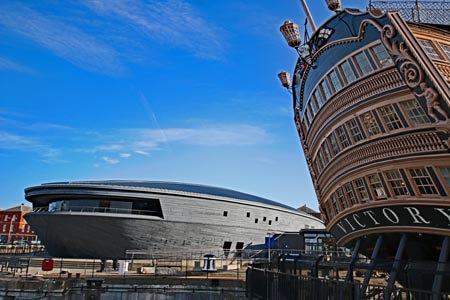
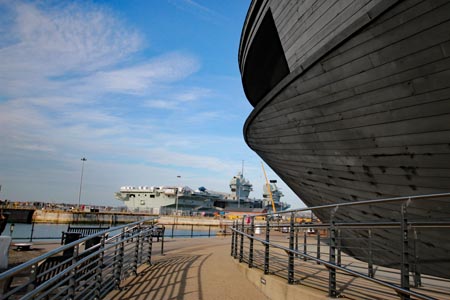
Since 2013 the Mary Rose and it's collection of hundreds of fascinating artefacts, have been on display at the Mary Rose Museum, close to Nelson's iconic warship HMS Victory.
The £35 million heritage project reunited the Mary Rose hull together with her collection of artefacts, placed in context, in a stunningly designed hull-shaped museum building.
Mary Rose Museum
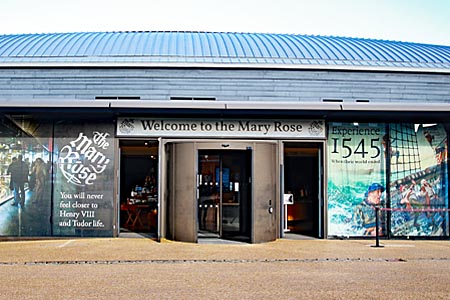
The Mary Rose Museum, designed by a team comprising Wilkinson Eyre Architects (architect), Pringle Brandon
(interior architect) and Land Design Studio (exhibition design and interpretation), in collaboration with
Gifford (structural and M&E engineer), reunites the ship's preserved hull with many thousands of
unseen artefacts for the first time in 500 years.
The project has been part funded by the Heritage Lottery Fund (HLF) contributing £21 million towards the
project, this has been matched by the Mary Rose Trust with a further £14 million raised from charitable
donations.
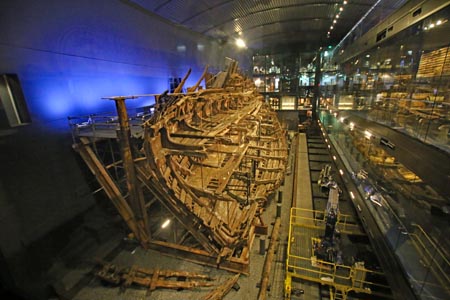
Showcasing the very best in 21st century architecture and construction, and the finest collection of 16th century artefacts in the world, for the first time visitors will see the ship with its preserving sprays switched off and will witness the final phase of the hull's conservation through windows into a 'hotbox' as up to 100 tons of water is now removed from the ship's timbers.
The exciting design of the Mary Rose Museum, has been developed to maintain as extensive visitor access as possible, balancing the specific conservation conditions necessary to the ship's preservation.
New galleries contain some of the thousands of objects recovered, in context, running the length of the ship, corresponding to deck levels so visitors can experience what the decks would have looked like moments before the Mary Rose sank. Six themed galleries tell the personal stories and working lives of the crew on board.
Henry VIII became King in 1509 at the age of just eighteen and one of his earliest actions was to
begin a programme of naval rearmament.
His father Henry VII had built a small fleet of ships, but the new King was very aware of the threat
of invasion by France and also the need to keep the English Channel open for international trade and commerce.
He set about expanding the navy and constructing and improving coastal defences particularly around The
Solent area improving castles such as Southsea Castle and defences at strategic locations such as the Hurst Straits between the Isle of Wight and the mainland, a strategic entry point to The Solent.
Henry VIII set about improving the navy by refitting and improving current ships such as the Sovereign and
the Regent, he also ordered the building of new ships such as The Mary Rose and The Peter Pomegranate. No records survive showing the design or plans of the new ships, but it is known that The Mary Rose was built at Portsmouth Dockyard to a new style using carvel planking. Carvel planking replaced the earlier clinker built design where planks are overlapped. In the carvel construction the planks of the hull were fitted edge to edge and fixed to the frame of the ship using large iron bolts. This new construction method allowed gun ports to be let into the hull of the ships on the various internal decks, which could be closed when not in use with a gun port lid.
The earliest known record of The Mary Rose at sea is from 29th July 1511, when payments were made by Robert Brygandyne, for the conveyance of two new ships the Mary Rose and the Peter Granade, to be delivered from Portsmouth to the Thames in London.
The Mary Rose saw action in 1512 when she was the flagship of Sir Edward Howard who with a fleet of 18 warships was given the task of clearing the English Channel. The fleet operated for 2 months carrying out this task and the Mary Rose returned undamaged to Portsmouth in July 1512.
In August 1512 the Mary Rose was part of an English fleet that attacked the French fleet anchored at Brest. A total of 32 French vessels were either burned or captured and 800 men were taken prisoner. In 1536 the Mary Rose was partially rebuilt and refitted in the River Medway in Kent. No records exist of the rebuild, but it is believed that modifications were made to the gun decks to allow the use of improved cannons, cast bronze muzzle loading guns.
In 1545 a French invasion fleet crossed the channel and on the July 18th they were anchored in St Helen Roads just off of the Isle of Wight coast. Henry was well aware of the invasion threat and had been in Portsmouth since July 15th to command the army and navy.
The gun batteries at Southsea Castle, The Square Tower and the Round Tower were armed and fully prepared to defend
the entrance to Portsmouth Harbour. The French fleet was much larger the English, so Henry adopted a defencive strategy rather than attacking the French.
In the ensuing action the Mary Rose sank very close to the coast, just off of Southsea castle. The French claimed that they had sunk the Mary Rose with cannon fire, but English records state that the ship was not hit, but had heeled over, possibly by a gust of wind and was sunk by water flooding through the gun ports which were open for action. Only 40 of the 700 men aboard survived the sinking and the ship became embedded in soft sediment of the seabed.
The battle itself was inconclusive, the French navy sailed back to the Isle of Wight, attacking and burning the towns of Brading, Sandown and Bonchurch, eventually withdrawing.
In 1836 early divers John and Charles Deane discovered the wreck of the Mary Rose recovering a bronze demi cannon. The site was well known by local fishermen who complained about their fishing lines regularly snagged on an underwater obstruction. John Deane later recovered three more guns from the site which were all handed over to the Board of Ordanance.
In 1965 Alexander McKee journalist and diver formed a group consisting of local amateur divers to survey and document several wrecks lying in the waters of The Solent.
This was known as 'Project Solent Ships'. Using a variety of techniques the divers excavated the Mary Rose wreck site and on the 5th May 1971 Percy Ackland uncovered some of the port side timbers of the Mary Rose.
In 1979 the Mary Rose Trust was formed with HRH Prince Charles as it's president. The trust planned to excavate the complete wreck site and document the ship and contents.
This work was carried out by 500 volunteer divers and shore based volunteers, overseen by a small number of professional staff. During the excavation approximately 19,000 thousand artefacts were recovered from the wreck site, these were carefully catalogued and stored.
Eventually in 1982, after years of meticulous excavation and planning, the hull of the Mary Rose was raised from the sea bed, supported by a custom built steel framework, by the floating crane Tog Mor.
Where is the Mary Rose:
Address: HM Naval Base, Portsmouth, PO1 3LJ
Telephone: 02392 812931